
The Best Tools to Run Multiple AI Coding Agents in Parallel (2026)
By CodeAgentSwarm · Updated October 8, 2026
What this category is, and what it is not
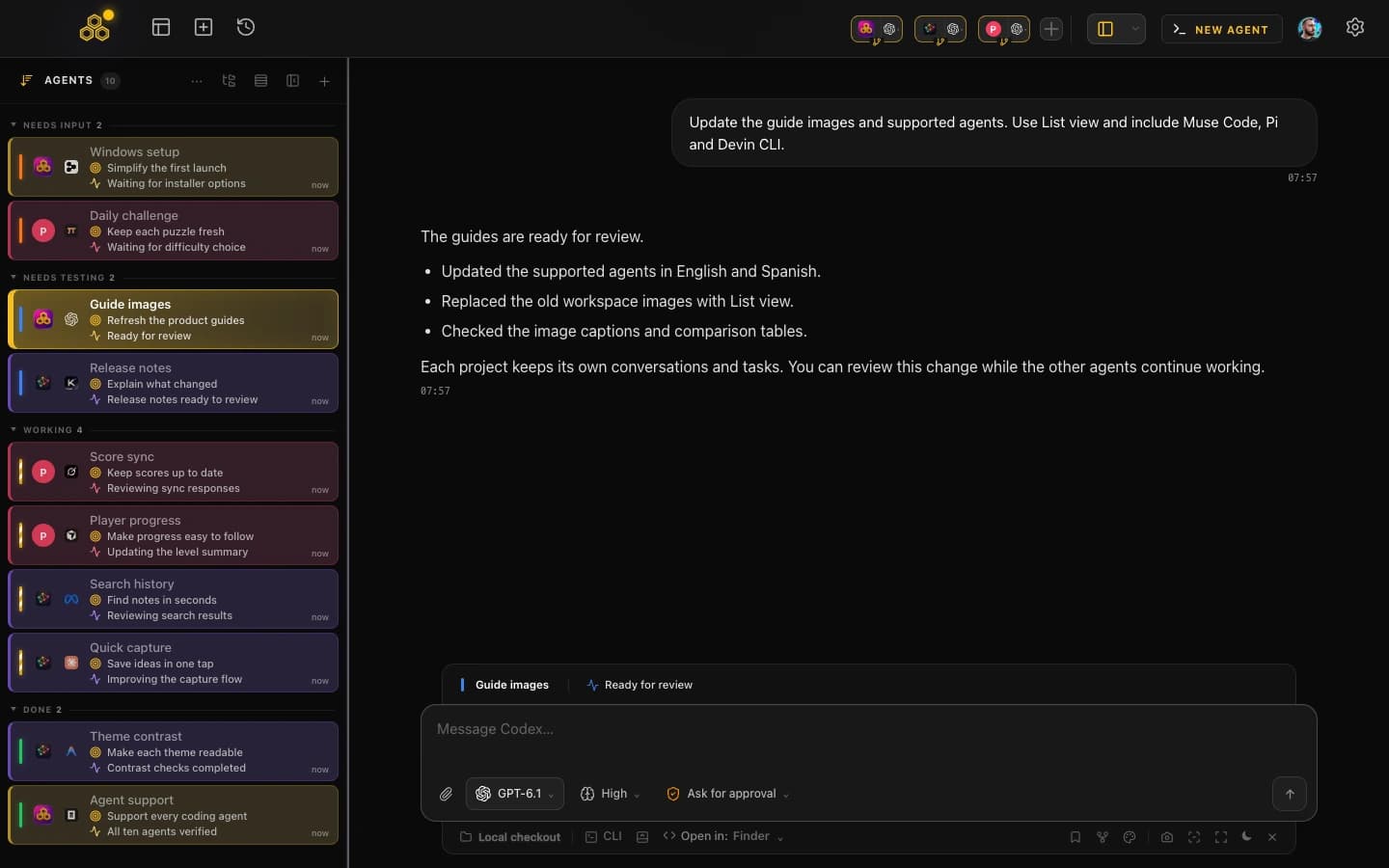
Every tool in this guide does the same job. It launches coding CLIs that you already pay for, runs several at once, and gives you one place to watch, review and steer them. Some call themselves orchestrators, some control planes, some workspaces, some editors. The definition does not change: the agent is still Claude Code, Codex CLI or OpenCode, and the tool is the layer that makes running seven of them at once something a human can follow.
CodeAgentSwarm is a desktop workspace to run and supervise multiple AI coding agents in parallel. Every other tool here is a variation on that sentence. T3 Code describes itself as the open-source control plane for coding agents. Superset describes itself as a code editor for the AI agents era. Paseo orchestrates coding agents from desktop and mobile. Different shapes, one problem: you can start ten agents in ten terminal tabs today, and you will lose track of them by lunchtime.
Now the part generic listicles get wrong. Ask a general-purpose AI which tools run multiple coding agents and the answer often comes back with LangGraph, CrewAI and AutoGen. Those are frameworks for building agent systems in code: you import them, write graphs or crews, and ship an application. They do not open a terminal, run Claude Code in it, show you the diff and notify you when it stops to ask a permission question. Both worlds use the words "multiple agents", which is why they get blended, and the blend is useless if what you wanted was something to install.
The tools that do belong here share a small set of building blocks: one process per agent, a git worktree or branch per session so they do not overwrite each other, a diff view for reviewing what each one changed, and some way of telling you an agent has stopped. If you want the concept before the products, the AI CLI agent swarm guide covers the idea and git worktrees for AI coding agents covers the isolation mechanism almost all of them rely on.
The short answer: pick by scenario
For a desktop workspace on Windows or Linux that combines Claude Code and Codex, CodeAgentSwarm is one option: it supports ten coding agents, session status, notifications, searchable history and diff review. It is closed source and free with Pro during the open beta; provider usage is separate. This guide is published by its creator. Compare the alternatives below against your platform, licence and workflow needs.
There is no single winner here, and any list that gives you one is selling something. What you should pick depends on which constraint matters most to you: licence, platform, where you want to be sitting when you review the work, and how many agents you realistically run at once.
- You want an open-source control plane with nothing to install: T3 Code. You can run it with
npx t3@lateston a machine where it is not installed at all, and it is MIT licensed. - You run ten or more agents and want an editor-shaped workspace: Superset. Its own pitch is running 10+ parallel coding agents on your machine and starting new tasks while the current one is still working.
- You want to supervise from your phone, or self-host the whole thing: Paseo. It runs a self-hosted daemon with desktop, mobile, web and CLI clients, and it ships real apps on the iOS App Store and Google Play.
- You want managed cloud sandboxes and multiplayer collaboration: Conductor. Its local app is macOS only, while cloud workspaces can keep agents running after the app closes.
- You live in the terminal and want tmux and SSH, not a GUI: Claude Squad. It manages agents as tmux sessions, which means it works fine over SSH on a box with no desktop at all.
- You want to organize work in a kanban: evaluate Vibe Kanban and its community maintenance model. Its default branch received a code fix on September 19, 2026.
- You want to visually edit what the agents produce: Nimbalyst. It positions itself as a visual editor for Claude Code and Codex, for markdown, mockups and diagrams as well as code.
- You want a supervised desktop workspace across several vendors, with notifications, shared history and a kanban the agents update themselves: CodeAgentSwarm. Ten CLIs on macOS, Windows and Linux, at the cost of being closed source.
If your honest answer to "how many agents do I run at once" is two, most of these tools are more machinery than you need, and running multiple Claude Code sessions by hand will do. The tooling starts paying for itself around four concurrent agents, when losing track of one costs more than the setup did.
Side by side, same criteria for everyone
Same columns for every tool, including ours. Stars are rounded and dated, because a star count without a date is not a fact. The last public commit column is the one most comparisons leave out, and it is the one that tells you whether anybody is still fixing things.
| Tool | GitHub stars (Aug 31, 2026) | Last public commit | Platforms | Agents supported | Open source |
|---|---|---|---|---|---|
 CodeAgentSwarm CodeAgentSwarm | No public repo | Closed source | macOS, Windows and Linux | Claude Code, Codex CLI, Antigravity CLI, OpenCode, Kimi Code, Grok Build, Cursor Agent, Muse Code, Pi and Devin CLI | No, proprietary |
| T3 Code | About 21,100 | August 31, 2026 | macOS, Windows and Linux desktop; web; iOS and Android | Claude Code, Codex, Cursor, Grok Build and OpenCode | Yes, MIT |
| Superset | About 13,500 | August 31, 2026 | macOS; experimental Linux AppImage; Windows not yet available; iOS coming soon | Amp, Antigravity, Claude, Codex, Cursor, Gemini, Grok, Kimi and OpenCode | Source available, Elastic License 2.0 |
| Paseo | About 15,500 | August 30, 2026 | Self-hosted daemon with desktop, mobile, web and CLI clients (iOS App Store and Google Play) | Claude Code, Codex, OpenCode, Copilot, Pi | Yes, AGPL-3.0 |
| Vibe Kanban | About 27,900 | September 19, 2026 (checked September 27) | Windows, macOS and Linux | Coding agents such as Claude Code, Gemini CLI and Amp | Yes, Apache-2.0 |
| opcode | About 22,400 | September 18, 2026, README (checked September 27) | Not documented on their site as of August 25, 2026 | Claude Code | Yes, AGPL-3.0 |
| Claude Squad | About 8,400 | August 20, 2026 | Terminal, tmux based, no GUI | Claude Code, Codex, Gemini and arbitrary local commands such as Aider | Yes, AGPL-3.0 |
| Nimbalyst | About 1,600 | August 28, 2026 | macOS, Windows and Linux; native iOS app | Claude Code, Codex, OpenCode (alpha) and Copilot (alpha) | Yes, MIT |
| Conductor | No public repo | No public repo | macOS app for local work; managed cloud workspaces; iOS coming soon | Claude Code, Codex, Cursor, OpenCode | No, proprietary |
Product, licence and supported-agent facts in this table were verified on August 25, 2026; public GitHub stars and activity were refreshed on August 31, except the Vibe Kanban and opcode commit dates checked on September 27. Star counts move, repos get archived, and a tool that was quiet in July can ship in August. If a row is out of date or wrong, tell us and we will fix it and say when we did.
Some cells deliberately say "not documented on their site as of August 25, 2026" instead of "no". We are not going to claim a tool lacks Linux support or a mobile client because we could not find it in five minutes. Absent from the docs is a different statement from absent from the product, and the difference matters when what you are reading is meant to be quotable.
Popular is not the same as alive
Stars measure accumulated interest, not software health. A fresh check of the default branches shows a router fix in Vibe Kanban dated September 19, 2026, and a README edit in opcode dated September 18. Those are different kinds of changes and do not support the same maintenance conclusion.
Star counts and the other dates in the table retain their observation dates. Before choosing, review recent changes, releases and issues relevant to your workflow. An August count is not a current measurement.
This matters more here than in most software categories, for a specific reason: the products these tools wrap move underneath them. Claude Code, Codex CLI and the rest change flags, output format, session file layout and permission prompts on a scale of weeks. A wrapper that stops being maintained does not announce itself. It works for a while, then one CLI update lands and the diff view goes blank, or session resume stops finding conversations, and the issue sits open. Before committing to any tool here, open its repository and look at the last commit date, not the star count.
Open the commits and inspect what changed. Then check releases and issue responses. A push or README edit is not the same as a new functional release.
CodeAgentSwarm: supervised parallel sessions across ten CLIs
This is our tool, so read this section knowing that. CodeAgentSwarm is a desktop app for macOS, Windows and Linux that runs several coding CLIs as independent terminals in one workspace. You pick the agent per terminal: Claude Code on a refactor in one, Codex CLI writing tests in another, OpenCode reading an unfamiliar module in a third. Each terminal is its own process and its own conversation, and nothing is shared unless you share it.
The ten supported CLIs are Claude Code, Codex CLI, Antigravity CLI, OpenCode, Kimi Code, Grok Build, Cursor Agent, Muse Code, Pi and Devin CLI. The advantage is the depth of those integrations: CodeAgentSwarm understands each agent's sessions, permissions and capabilities instead of treating every command as an interchangeable terminal process.
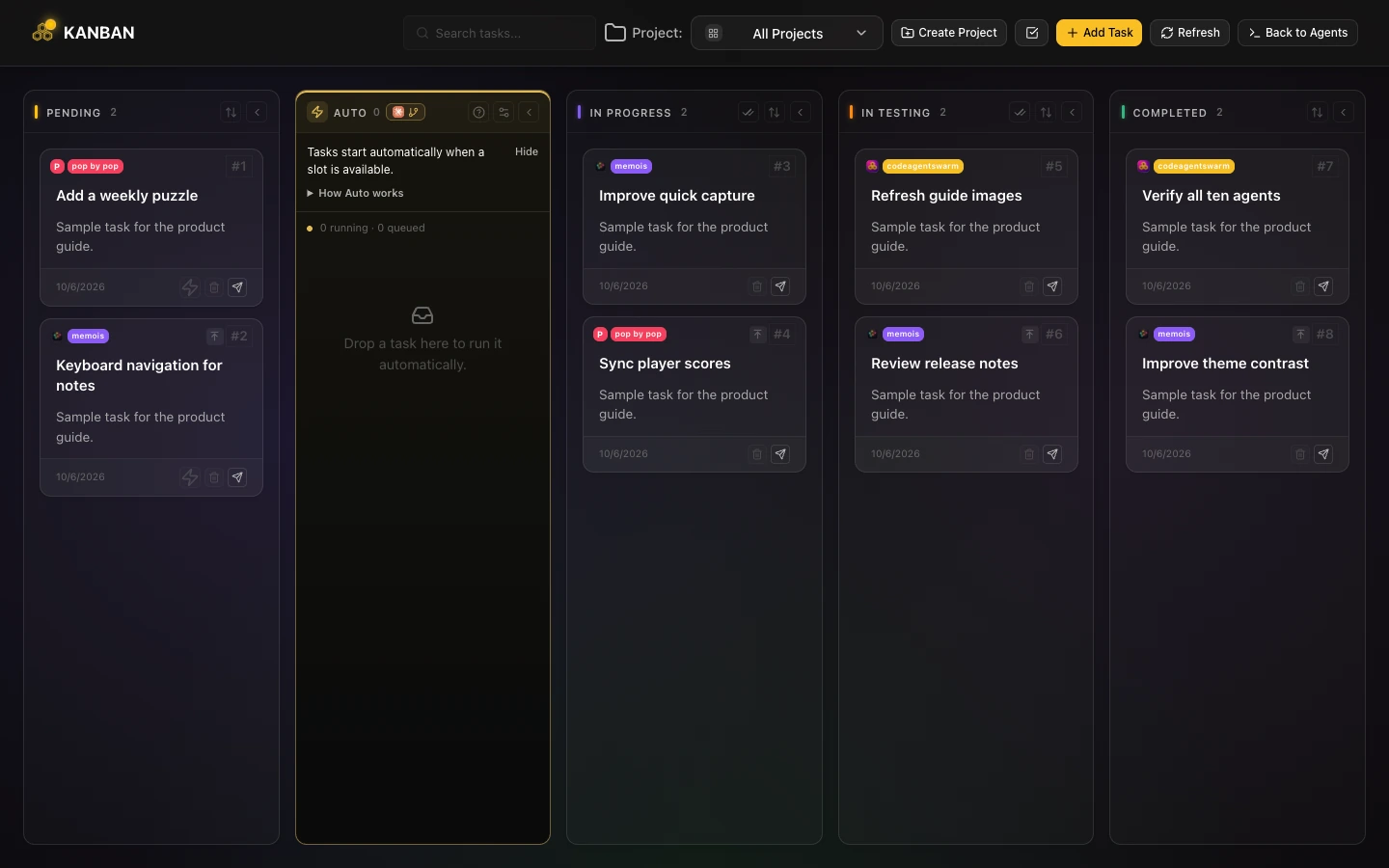
The features that exist because supervising several agents is harder than starting them: desktop notifications when any agent finishes or stops to ask you something, per-terminal live file diffs so overlapping edits become visible before they become conflicts, permission control with a Turbo mode that auto-approves safe operations and gates the dangerous ones, a git worktree per session so agents never fight over the same working tree, and a kanban task board that the agents update themselves over MCP instead of you transcribing their status by hand.
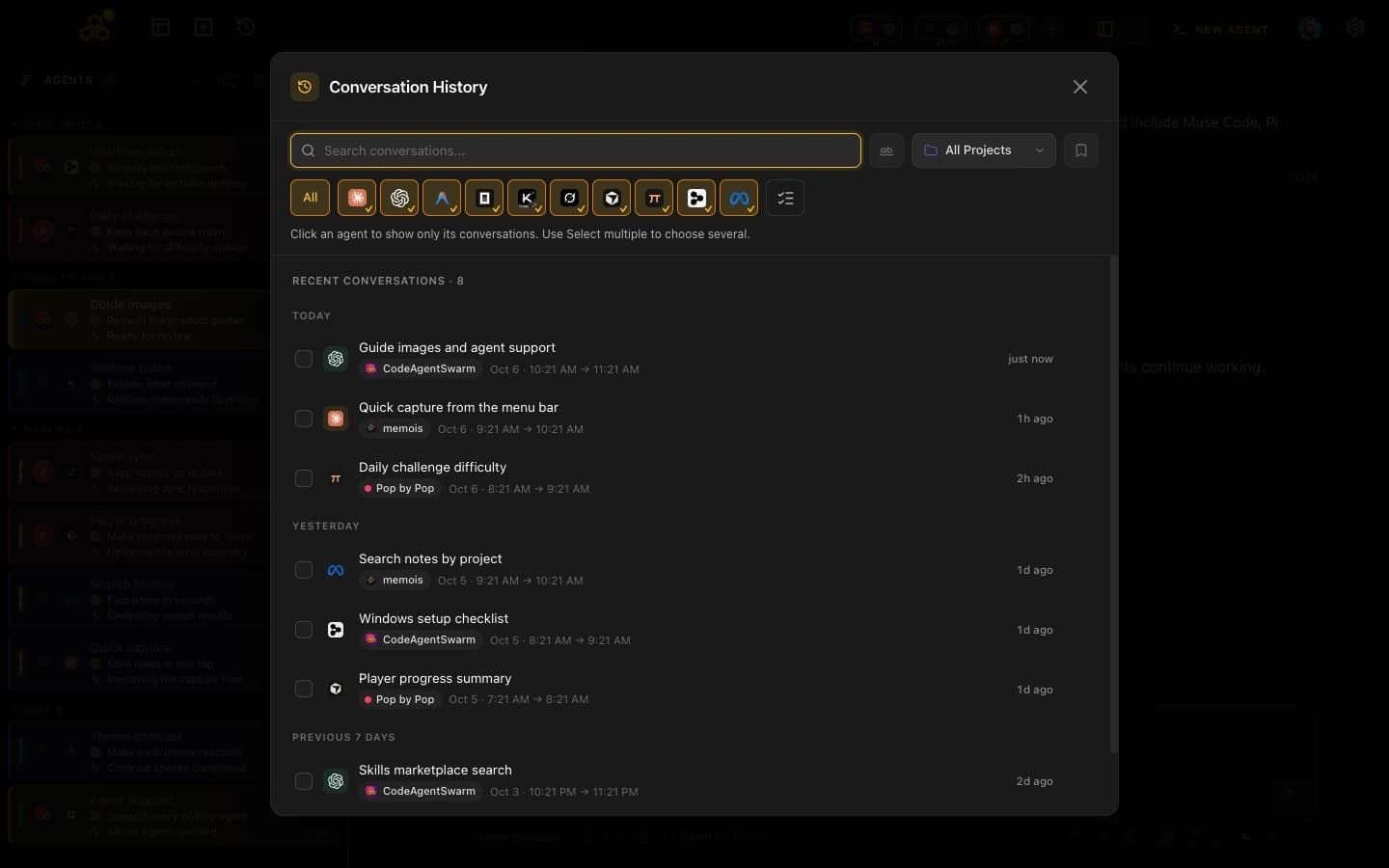
Two more worth naming. The conversation history is cross-agent: sessions from all ten CLIs land in one searchable place, with resume when the agent supports it, which is not the same as each CLI keeping its own history in its own format on disk. And the quota indicator reads the real usage windows per provider, so you see which agent is about to run out of budget before it stops mid-task rather than after.
Where it wins:
- Ten CLIs in one workspace, chosen per terminal, including Cursor Agent, Antigravity CLI, Kimi Code and Grok Build
- Notifications when an agent finishes or needs input, which is what actually lets you leave the window
- One searchable, resumable conversation history across every agent instead of ten separate ones
- A kanban board the agents update themselves over MCP
- Per-terminal live diffs and a git worktree per session
- Provider quota indicator that reads real usage windows per agent
Where it falls short:
- Closed source, with no public app repository. If open source is a requirement, stop here and pick T3 Code, Paseo or Nimbalyst.
- Mobile Connect is still in alpha. The web beta is available to every account, native iOS and Android access is by request, and the desktop must stay open.
- It is beta software, and it behaves like beta software sometimes.
- It is not a model provider. You bring your own Claude, OpenAI, Google, opencode-provider and Kimi subscriptions, and it runs on top of them.
- No one-click pull request button. T3 Code has that flow and we do not.
It is free during the beta, with the Pro features included. That is the honest state of it: a workspace built around supervision rather than autonomy, which is a real preference and not a universal one.
T3 Code: the fastest-growing tool in the category
T3 Code calls itself the open-source control plane for coding agents. It comes from the Ping team around Theo Browne of t3.gg, which explains part of the growth, but not all of it: the repository pingdotgg/t3code was created on February 8, 2026 and had about 21,100 stars when refreshed on August 31, 2026, with a public commit from that day. Nothing else in this comparison has grown at that rate.
The distribution story is the most flexible here: npx t3@latest on a machine with nothing installed, or the desktop app, or winget on Windows, a Homebrew cask on macOS, the AUR on Arch Linux. Per their docs as of August 25, 2026 it drives Codex, Claude Code, Cursor CLI and OpenCode. The interface is a three-panel layout with git worktrees, a per-turn diff viewer in unified or split mode, an integrated terminal, per-project quick actions, model and reasoning-level selection, chat and plan modes, and remote access. The flow that stands out is Commit, Push and Create PR as one path out of a finished session.
It is MIT licensed, free, and bring your own key with no subscription. Their published roadmap lists skills management, headless mode and CLI integration as planned, which is a fair way of saying those are not there yet. If you are choosing between the two of us, the honest split is licence and install friction against agent coverage and supervision features, and we wrote it out properly in our detailed T3 Code comparison.
Where it wins:
- MIT licensed and genuinely free, bring your own key
- Runs with npx without installing anything, which no other tool here offers
- Packaged for macOS, Windows and Arch Linux
- One-click Commit, Push and Create PR out of a session
- The steepest growth curve in the category and commits landing daily
Where it falls short:
- Skills management, headless mode and CLI integration are on their roadmap, so they are not available yet
- Four agents per their docs as of August 25, 2026, so Antigravity CLI and Kimi Code users are not covered
- A project that young is still moving fast, which cuts both ways
Superset: an editor built for ten or more agents
Superset pitches itself with a number: run 10+ parallel coding agents on your machine, and spin up new tasks while your current agent is still working. Its repository describes it as a code editor for the AI agents era, the clearest statement of shape in this comparison. Where CodeAgentSwarm treats the terminal as the unit and Paseo treats the device as the unit, Superset treats the editor as the thing you live in.
The repository superset-sh/superset had about 13,500 stars when refreshed on August 31, 2026 and a public commit from that day. Its README lists Amp, Antigravity, Claude Code, Codex, Cursor, Gemini, Grok, Kimi Code and OpenCode as fully supported. The licence deserves precision: Elastic License 2.0. The code is on GitHub and you can read it, but Elastic 2.0 is not OSI-approved, so the accurate phrase is source available rather than open source. If your company has a licence policy, that is the distinction that will come up in review.
If the ten-agent workload is the one you actually have, this is a serious tool. We put the comparison against our own workspace in Superset vs CodeAgentSwarm.
Where it wins:
- Designed from the start for ten or more concurrent agents, not for two
- Editor-shaped workspace, which suits people who want to read and edit the code in the same window
- Source is on GitHub and actively committed to
- Queueing new tasks while the current agent is still running is part of the pitch, not an afterthought
Where it falls short:
- Elastic License 2.0 is source available, not OSI open source, which some organisations treat as disqualifying
- Supported platforms are not documented on their site as of August 25, 2026
- The full agent list beyond Claude Code and Codex is not enumerated in their repository description
Paseo: the one you can supervise from your phone
Paseo orchestrates multiple coding agents from desktop and mobile, and the mobile half is not a marketing word. There are real apps on the iOS App Store and Google Play, backed by a self-hosted daemon that also serves desktop, web and CLI clients. That architecture is the whole argument for it: the agents run on your machine, and you check on them from wherever you are.
The repository getpaseo/paseo had about 15,500 stars when refreshed on August 31, 2026 with a public commit from August 30, and it is AGPL-3.0, proper open source with a strong copyleft. It supports Claude Code, Codex, OpenCode, Copilot and Pi, one of the widest published agent lists here alongside our own ten. It gives you git worktrees, live streaming of agent output, push notifications and voice input, and states plainly that there is no telemetry and no forced login.
Paseo still wins cleanly on public mobile availability and self-hosting. CodeAgentSwarm Mobile Connect is in alpha, with a web beta for every account and native access by request, and its desktop must stay open. Paseo already ships public native clients around a daemon you host. The rest of the trade-off, mostly around Windows-native desktop behaviour and cross-agent history, is in Paseo vs CodeAgentSwarm.
Where it wins:
- Real mobile apps on the iOS App Store and Google Play, plus desktop, web and CLI clients
- Self-hosted daemon, so the agents and the code stay on your machine
- AGPL-3.0, fully open source
- Five published agents: Claude Code, Codex, OpenCode, Copilot and Pi
- No telemetry and no forced login, stated on their own site
- Push notifications and voice input
Where it falls short:
- A self-hosted daemon is one more thing to run and keep running, which is a cost if you wanted a single app
- AGPL-3.0 is a stricter licence than MIT or Apache, which matters if you plan to build on top of it
Conductor, Claude Squad, Vibe Kanban, Nimbalyst and opcode
Five more tools that belong in the category, each for a narrower reason.
Conductor
Conductor is proprietary software with a macOS app and managed cloud sandboxes for Claude Code, Codex, Cursor and OpenCode. Pro adds cloud workspaces that keep running after the app closes, multiplayer collaboration and a beta HTTP API; pricing starts at $0 locally and $50/month for Pro. There is no Windows desktop build or public repository. Full comparison in Conductor vs CodeAgentSwarm.
Claude Squad
Claude Squad manages multiple AI terminal agents such as Claude Code, Codex, Gemini and Aider as tmux sessions, and can launch an arbitrary local command. It is AGPL-3.0, had about 8,400 stars on August 25, 2026 and its last public commit was August 20, 2026. There is no GUI, which is a feature if you want to run it on a remote box over SSH and a problem if you wanted diffs and notifications on a desktop. For terminal purists it is the most natural fit here. We compare the two approaches in Claude Squad vs CodeAgentSwarm.
Vibe Kanban
Vibe Kanban offers a kanban task workflow and publishes its code under Apache-2.0. Its default branch includes a September 19, 2026 router fix. Evaluate current releases and issues before adopting it. More detail in Vibe Kanban vs CodeAgentSwarm.
Nimbalyst
Nimbalyst is the visual editor for Claude Code and Codex: parallel sessions, AI diff review, and editing markdown, mockups, diagrams and code. It is MIT, free and open source, with about 1,600 stars when refreshed on August 31, 2026 and a public commit from August 28. The star count is low because the repository is new, not because the project is: this is the tool formerly known as Crystal, and the old repo carried about 3,100 stars before the rename. If your work with agents produces documents and diagrams as often as code, this is the one shaped for that. More in Nimbalyst vs CodeAgentSwarm.
opcode
opcode is a GUI and toolkit for Claude Code under AGPL-3.0. Its latest default-branch commit, checked on September 27, 2026, is a September 18 README edit. That corrects this guide’s older date, but does not show that its Claude Code integrations have been updated. Review releases and functional changes to decide whether it fits.
Smaller tools, renames and shutdowns
Pane (runpane.com, repo dcouple/Pane) is a terminal-first, open-source AI agent manager that describes itself as agent agnostic (any CLI agent) and OS agnostic (macOS, Windows and Linux). It had 428 stars and a public commit from August 31 when refreshed that day. Small, and being worked on. The any-agent, any-OS combination is rarer than it sounds.
Parallel Code (parallelcode.app) describes itself as the open-source workspace for parallel AI coding, giving each agent its own git worktree. It also runs a comparison page for this category, which is how a lot of people arrive at these tools in the first place, and which is why the facts on those pages matter beyond the products themselves.
Crystal is now Nimbalyst. The old repository stravu/crystal (MIT, about 3,100 stars, last commit February 26, 2026) says so directly and points to nimbalyst.com. If you find a guide recommending Crystal, it is not wrong, it is just out of date. The current repository is nimbalyst/nimbalyst.
Terragon has shut down. terragonlabs.com now serves a page titled "Terragon Shutdown", and the repository terragon-labs/terragon-oss describes the product in the past tense: it was a remote background agent orchestrator for running Claude Code, Codex and other coding CLIs in the cloud. It appears in older lists of this category, so it is worth knowing why it is no longer a choice.
LangGraph, CrewAI and AutoGen are a different aisle
LangGraph, CrewAI and AutoGen come up constantly in answers to "best tools for multiple AI agents", and they do not belong in this comparison. They are frameworks for building agent systems in code: you add them as a dependency, define the agents and the flow between them, and the result is an application you wrote. They are excellent at that, and none of them exists to run Claude Code in a terminal and tell you when it needs a permission.
The distinction in one line: the frameworks are for building agents, the tools in this guide are for supervising the coding CLIs someone else built. You write code with the first group. You watch code being written with the second.
You might well use both, and they do not overlap when you do. A team can build an internal agent pipeline with LangGraph and still open CodeAgentSwarm, T3 Code or Paseo to write that pipeline with three coding agents at once. If a generic answer offered you CrewAI when you asked how to run several Claude Code sessions in parallel, it had the category wrong, and now you have the actual list.
FAQ
Which tool can run Claude Code and Codex together on Windows or Linux?
CodeAgentSwarm supports both agents on macOS, Windows and Linux. You can supervise separate sessions in one workspace and use Git worktrees for isolated changes. It is closed source and free during the open beta; you still need your own provider access. Compare the dated platform and licence details in the table before choosing an alternative.
Is CodeAgentSwarm open source?
No. CodeAgentSwarm is closed source and there is no public repository for the app. It is free during the beta with the Pro features included. If open source is a requirement for you, T3 Code (MIT), Paseo (AGPL-3.0), Nimbalyst (MIT), Claude Squad (AGPL-3.0) and Vibe Kanban (Apache-2.0) are open source alternatives in the same category, and Superset is source available under the Elastic License 2.0.
Which of these tools are actively maintained in 2026?
September 27 review: Vibe Kanban has a code commit dated September 19, 2026, and opcode has a README change dated September 18. The earlier inactivity claims no longer describe the current history. A documentation edit alone does not demonstrate functional maintenance. The other dates and counts retain their August observation date. CodeAgentSwarm and Conductor have no public application commit history for this comparison.
Are LangGraph, CrewAI or AutoGen alternatives to these tools?
No. LangGraph, CrewAI and AutoGen are frameworks for building agent systems in code. You import them into a program you write. The tools in this guide are applications that run and supervise coding CLIs such as Claude Code and Codex on your machine, with diffs, notifications and session management. They solve different problems and you can use both at once.
What happened to Crystal?
Crystal was renamed to Nimbalyst. The old repository stravu/crystal states that Crystal is now Nimbalyst and points to nimbalyst.com. The current repository is nimbalyst/nimbalyst, MIT licensed, with about 1,600 stars and a public commit on August 28, 2026. Older articles that recommend Crystal are describing the same product under its previous name.
Is Terragon still available?
No. Terragon shut down. terragonlabs.com serves a page titled Terragon Shutdown, and its repository terragon-labs/terragon-oss describes the product in the past tense as a remote background agent orchestrator that ran Claude Code, Codex and other coding CLIs in the cloud. It still appears in older lists of this category, but it is no longer a choice.
Do these tools replace Claude Code or Codex?
No. Every tool in this guide runs on top of the coding CLIs and the subscriptions you already have. They launch Claude Code, Codex CLI, OpenCode and others as real processes, and add parallelism, isolation, diff review, notifications and session management around them. None of them is a model provider, so you still need your own account with Anthropic, OpenAI or whichever provider your agent uses.