
Vibe Kanban vs CodeAgentSwarm: An Honest Comparison (2026)
By CodeAgentSwarm · Updated October 5, 2026
The one-sentence difference
Vibe Kanban turns agent work into a kanban of issues that a team can plan and review, while CodeAgentSwarm lets you run and supervise the agent terminals themselves, with a task board as one part of a wider workspace.
Put another way: their product is the board, ours is the room where the agents work. For the wider field, see the best tools to run multiple AI coding agents, and if the board itself is what you care about, our Claude Code task management guide shows how agents update tasks over MCP.
Disclosure: CodeAgentSwarm is our product, so read this as an interested comparison and verify the claims. All third-party facts here were checked on August 25, 2026 against vibekanban.com, the public BloopAI/vibe-kanban README and public GitHub data. Where their documentation does not cover something, we say it is not documented rather than claiming it is missing.
What Vibe Kanban is
Vibe Kanban describes itself as project management for teams building with AI coding agents. You plan work as kanban issues, then create a workspace where an agent executes: their README says each workspace gives an agent a branch, a terminal and a dev server. You review the diff, leave inline comments that go straight back to the agent, preview the app in a built-in browser and open a pull request with an AI-written description.
It starts with a single command, npx vibe-kanban, and their README lists support for more than ten coding agents: Claude Code, Codex, Gemini CLI, GitHub Copilot, Amp, Cursor, OpenCode, Droid, CCR and Qwen Code. Their docs also cover a Vibe Kanban MCP server, GitHub and Azure Repos integrations, a VSCode extension and self-hosting with Docker Compose.
- Open source under Apache-2.0, with roughly 27,900 stars on GitHub (27,907 on August 25, 2026), the largest community of any tool in this comparison
- Kanban issues as the primary unit of work, built for teams rather than one developer
- Diff review with inline comments sent back to the agent without leaving the UI
- A built-in browser preview with devtools, inspect mode and device emulation
- Pull request creation and merge from inside the tool
- Last public commit on the default branch: September 19, 2026
There is one more fact you should have before choosing it, and it comes from their own site. On April 10, 2026 the company behind Vibe Kanban, bloop, published an announcement that it was shutting down, and that the project would continue as open source and community maintained. The same announcement says remote services stayed available for 30 days and then Vibe Kanban moved to a fully local architecture, with the remote pieces removed being kanban issues, comments, projects and organisations, while local workspaces keep working. The README on their default branch carries a sunsetting banner pointing at that post.
We are stating dates, not delivering a verdict. Apache-2.0 code with 27,900 stars does not evaporate, and community-maintained projects can outlive their companies. Read the announcement, check the repository activity yourself, and decide what that means for the way your team works.
What CodeAgentSwarm is
CodeAgentSwarm is a desktop workspace to run and supervise multiple AI coding agents in parallel. It runs on macOS, Windows and Linux, each terminal is a real agent process, and you pick the agent per terminal from Claude Code, Codex CLI, Antigravity CLI, OpenCode, Kimi Code, Grok Build, Cursor Agent, Muse Code, Pi and Devin CLI.
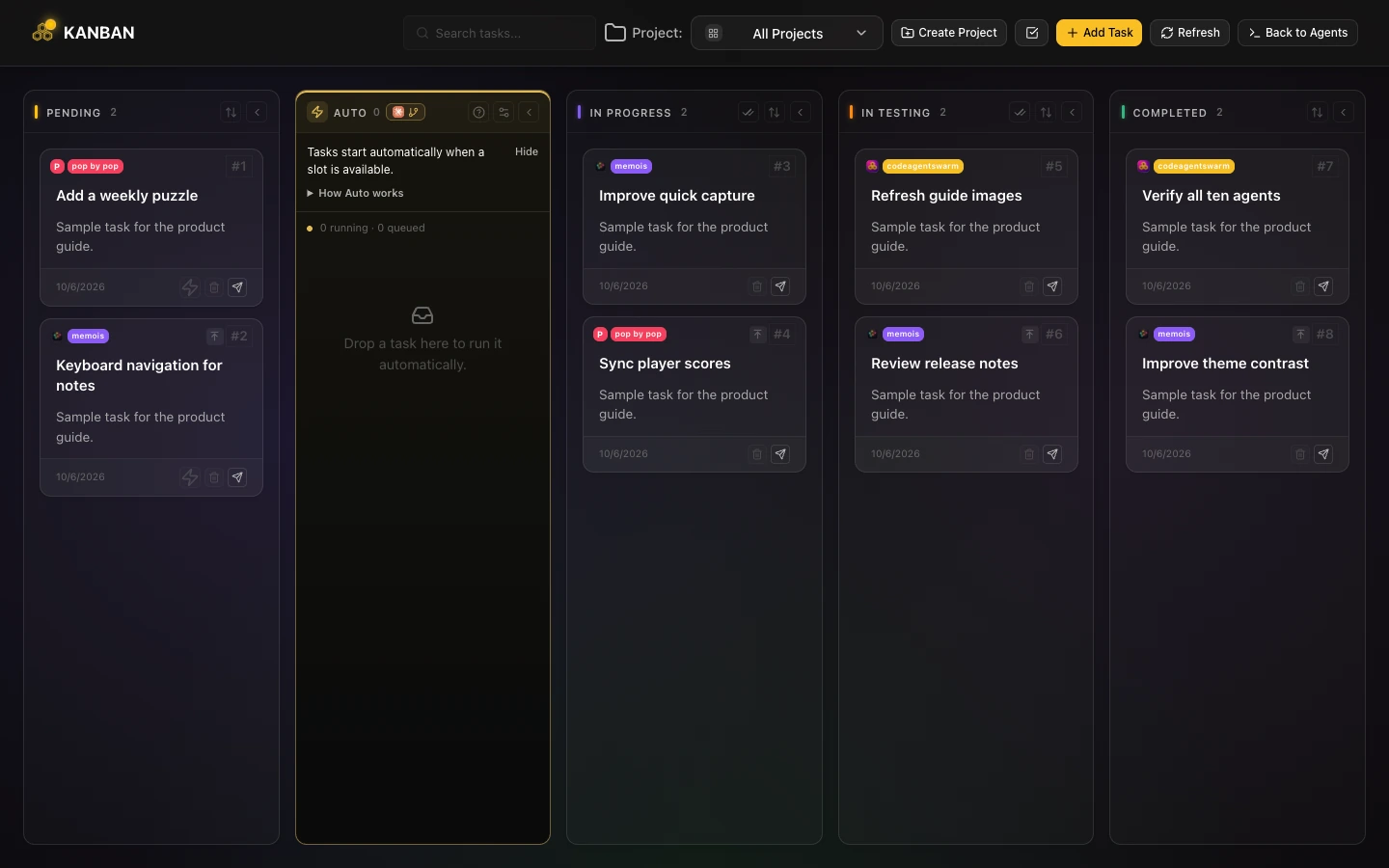
The board exists, but it is not the point. The point is supervision: desktop notifications when an agent finishes or needs input, searchable conversation history across all ten agents and capability-aware resume, per-terminal live file diffs, permission control with a Turbo mode, git worktrees per session, multi-project switching, AI commit messages, a provider quota indicator, and skills and MCP marketplaces shared across agents.
Our limits, plainly: closed source with no public repository, Mobile Connect still in alpha (web beta for every account, native iOS and Android access by request, desktop must stay open), still in beta with Pro included, and we are not a model provider, so you bring your own subscriptions.
Side by side
| Vibe Kanban |  CodeAgentSwarm CodeAgentSwarm | |
|---|---|---|
| Platforms | Runs locally with npx vibe-kanban and is used in the browser; Docker Compose self-hosting documented | Desktop app for macOS, Windows and Linux |
| Interface | Kanban board and workspace UI in the browser, with a built-in app preview | Desktop workspace with live terminal panes |
| Supported agents | Claude Code, Codex, Gemini CLI, GitHub Copilot, Amp, Cursor, OpenCode, Droid, CCR and Qwen Code per their README | Claude Code, Codex CLI, Antigravity CLI, OpenCode, Kimi Code, Grok Build, Cursor Agent, Muse Code, Pi and Devin CLI |
| Isolation model | One workspace per issue, each with its own branch, terminal and dev server | A separate process per terminal, with optional git worktrees per session |
| Notifications | Not documented on their site as of August 25, 2026 | Desktop notifications when an agent finishes or needs input |
| Conversation history | Sessions per workspace with a chat interface and a changes panel, documented per workspace | Searchable history across all ten agents and capability-aware resume |
| Task management | The whole product: kanban issues, filtering, board customisation, team assignment | One feature of the workspace: a kanban the agents update over MCP |
| Open source | Yes, Apache-2.0, roughly 27,900 stars | No, closed source with no public app repository |
| Price | Open source and self-hostable; the paid cloud subscriptions were terminated per their April 10, 2026 announcement | Free during beta with Pro included, and you bring your own agent subscriptions |
| Last public commit (verified Sep 27, 2026) | September 19, 2026 | Closed source, no public repo |
When Vibe Kanban is the better choice
- Your unit of work is an issue, not a session. If planning and assigning tickets is the job and agents are how the tickets get done, a kanban-first tool matches that model better than a terminal workspace.
- You want open source you can host. Apache-2.0, roughly 27,900 stars, and documented Docker Compose self-hosting. Our app is closed source and there is nothing to self-host.
- You review in the browser. Inline comments on a diff that go straight back to the agent, plus a built-in preview with devtools and device emulation, are genuinely nice and we do not have an equivalent.
- You want more agent choices. Their README lists more than ten agents, including Cursor, Amp, Droid and Qwen Code. Our list is ten.
- You want pull requests handled in the tool. Opening a PR with an AI-written description and merging from the same UI is part of their flow.
- You want nothing to install. It runs from npx wherever Node runs. CodeAgentSwarm is a desktop app you install.
When CodeAgentSwarm is the better choice
- You want to see the agents work. Live terminal panes, per-terminal file diffs as they happen, and titles that tell you what each session is on right now.
- You want to be interrupted, not to poll. Desktop notifications tell you the moment an agent finishes or stops to ask a question.
- You use Antigravity CLI or Kimi Code. Neither is listed among the agents in the Vibe Kanban README as of August 25, 2026. Both are first-class here, alongside Claude Code, Codex CLI and OpenCode.
- You want one searchable history across vendors. Every conversation from every agent in one search box and capability-aware resume from any point.
- You want permission control per operation. Turbo mode auto-approves what you trust and keeps the rest gated, instead of an all-or-nothing switch.
- You want to know your quota before the agent stalls. The provider quota indicator shows how much allowance is left.
- You want a maintained desktop app on Windows or Linux. We ship signed builds for macOS and Windows, .deb and AppImage builds for Linux, and update them regularly.
Using both
It is a reasonable pairing. Plan and triage the team backlog in Vibe Kanban, then supervise the actual execution in CodeAgentSwarm, where you can watch several agents at once and get told when one needs you. Both work on top of git branches, so nothing about the repository layout has to change.
Comparing more than these two? The Claude Squad comparison covers the terminal-first approach, and Nimbalyst, formerly Crystal, covers the visual editor approach.
FAQ
Is Vibe Kanban open source?
Yes. Vibe Kanban is published at github.com/BloopAI/vibe-kanban under the Apache-2.0 license, with roughly 27,900 stars (27,907 when verified on August 25, 2026), the largest community of any tool compared here. CodeAgentSwarm is closed source with no public application repository.
Is Vibe Kanban still maintained?
The default branch received a router fix on September 19, 2026, checked on September 27. The April bloop shutdown announcement described the project continuing as community-maintained open source. The company shutdown should not be confused with an absence of project commits.
Can I still use the Vibe Kanban cloud and team features?
Their April 10, 2026 announcement states that remote services stayed available for 30 days and were then removed, with Vibe Kanban transitioning to a fully local architecture. The remote pieces listed as being removed are kanban issues, comments, projects and organisations, paid subscriptions were terminated with refunds for the previous 30 days, and local workspaces continue to function. The latest version at that time included a data export feature. Check their site for the current state before planning a team rollout.
Does Vibe Kanban support Antigravity CLI or Kimi Code?
Neither is listed among the coding agents in the Vibe Kanban README as of August 25, 2026, which names Claude Code, Codex, Gemini CLI, GitHub Copilot, Amp, Cursor, OpenCode, Droid, CCR and Qwen Code. CodeAgentSwarm supports Antigravity CLI and Kimi Code directly, along with Claude Code, Codex CLI and OpenCode.