
How to schedule Cursor Agent: Automations vs a local schedule
By CodeAgentSwarm · Updated October 31, 2026
How do I schedule Cursor Agent?

- In Cursor's cloud: an Automation with a schedule trigger. Your computer can be off.
- On your machine, log only: cron calls the CLI in print mode.
- On your machine, with a conversation: CodeAgentSwarm runs the Cursor Agent CLI at the times you set.
Cursor Automations
You create Automations in the Agents window, at cursor.com/automations or with /automate from an agent session. A schedule trigger takes presets or a cron expression; runs may start late but never early. Each run is a Cloud Agent, billed as cloud agent usage, and cron triggers start with no repository, so you pick one if the run must change code. Cursor Automations docs
That is the right tool for work on a GitHub repository that must happen with your laptop closed. For jobs that need your local checkout or services running on your machine, schedule the CLI itself.
A Cursor Agent cron job in print mode
# crontab -e: weekdays at 08:00
0 8 * * 1-5 cd ~/code/my-app && agent -p "Run the tests and explain failures. Do not edit files." --output-format text >> ~/logs/cursor-cron.log 2>&1
Print mode only proposes edits unless you pass --force; set CURSOR_API_KEY for unattended auth. Cursor CLI headless docs
Schedule Cursor Agent in CodeAgentSwarm
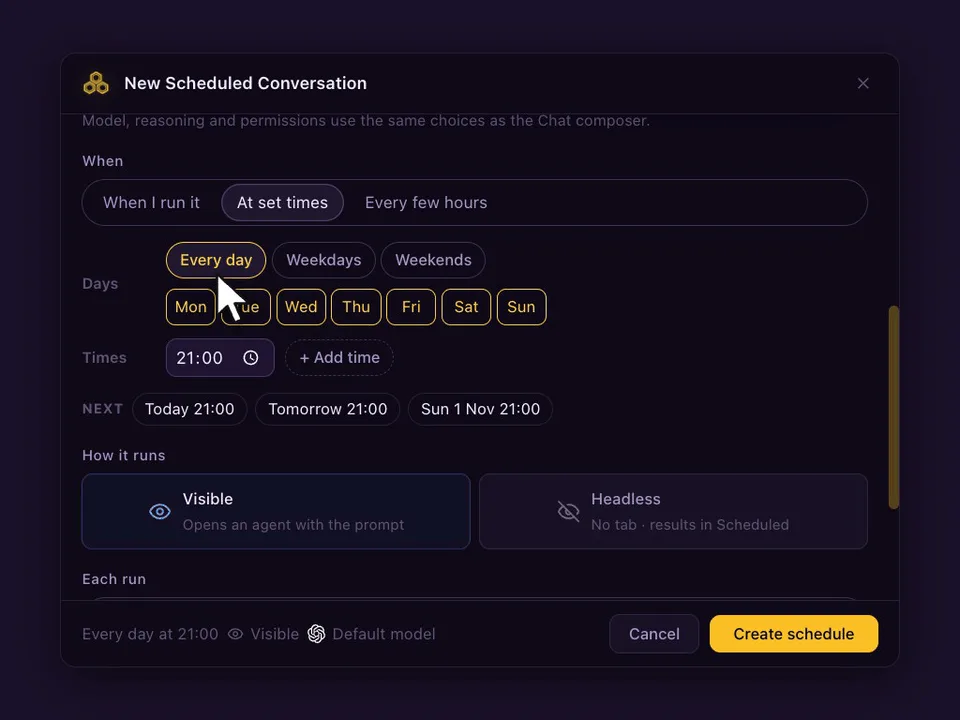
- Open Scheduled in the top bar and press New schedule. Or type the prompt in a Cursor Agent Chat and pick Schedule this prompt… from the send menu.
- Pick the Project and choose Cursor Agent as the agent. Model, reasoning and permissions are optional: leave them on Default or set them like in the Chat composer.
- Write the prompt the agent should run every time.
- Under When, choose At set times (up to 24 a day), Every few hours (1, 2, 3, 4, 6, 8 or 12) or When I run it, and the days.
- Choose Visible (opens a Chat) or Headless (no tab, result in Scheduled), and whether each run continues the same conversation or starts a new one. Press Create schedule.
Prompts worth scheduling with Cursor Agent
- Every weekday at 08:00: run the tests on the local branch and explain failures.
- Every 6 hours: check the dev server log in this project and summarise new errors.
- Fridays at 16:00: find components without tests and list them by size.
What happens on each run
- With Continue the same conversation, a visible run goes to the Cursor Agent agent that already holds the conversation, and never opens a second copy. With Start a new conversation, each run opens a fresh agent. If it is busy, Skip if still working (on by default) skips that slot; turn it off and the prompt waits in the queue.
- The Chat marks every scheduled run, so you can tell your own messages from the scheduled ones and reply to a run like any other message.
- If CodeAgentSwarm was closed or the computer asleep at the set time, If missed, run when the app opens runs it once, late. A week away gives one run, not seven.
- Schedules run on your computer, so CodeAgentSwarm has to be open. Your phone can list, edit and run them from the Scheduled tab.
FAQ
Do Cursor Automations run on my computer?
No. Each run is a Cursor Cloud Agent in Cursor's cloud, billed as cloud agent usage.
Can the Cursor Agent CLI run on a schedule?
The CLI docs describe print mode but no scheduler, and Automations run as cloud agents. To run the CLI locally on a schedule, call it from cron or use CodeAgentSwarm.
Which should I pick?
Automations for repository work that must run with your laptop off. A local schedule for work that needs your files, tools and running services.